

INU Professor Hwan-ho Cho’s Research Team Collaborates with Hanyang University Guri Hospital to Develop AI Model for Automatic Detection of Silent Cerebral Infarction
- 글번호
- 424073
- 작성일
- 2026-05-14
- 수정일
- 2026-05-14
- 작성자
- 홍보과 (032-835-9490)
- 조회수
- 498

From left: Professor Hwan-ho Cho of Incheon National University (First Author) and Professor Seong-ho Park of the Department of Neurology at Hanyang University Guri Hospital (Corresponding Author)
Incheon National University (President: In-jae Lee) announced that a research team led by Professor Hwan-ho Cho of the School of Electrical Engineering collaborated with the research team of Professor Seong-ho Park from the Department of Neurology at Hanyang University Guri Hospital to develop an artificial intelligence model that automatically detects newly developed cerebral infarction lesions using serial MRI scans.
This study focused on identifying new cerebral infarctions that were not visible in previous MRI scans by comparing MRI images taken at different time intervals. In particular, the model was designed to systematically detect silent cerebral infarctions, which may occur even when patients show no apparent symptoms.
The research team developed a time-series deep learning model that simultaneously utilizes baseline and follow-up MRI scans as inputs, with performance evaluation centered on FLAIR MRI imaging for detecting subtle lesions. As a result, the proposed model successfully detected newly developed cerebral infarctions with high accuracy across diverse clinical datasets and demonstrated significant performance even for small lesions that are easily overlooked in clinical practice.
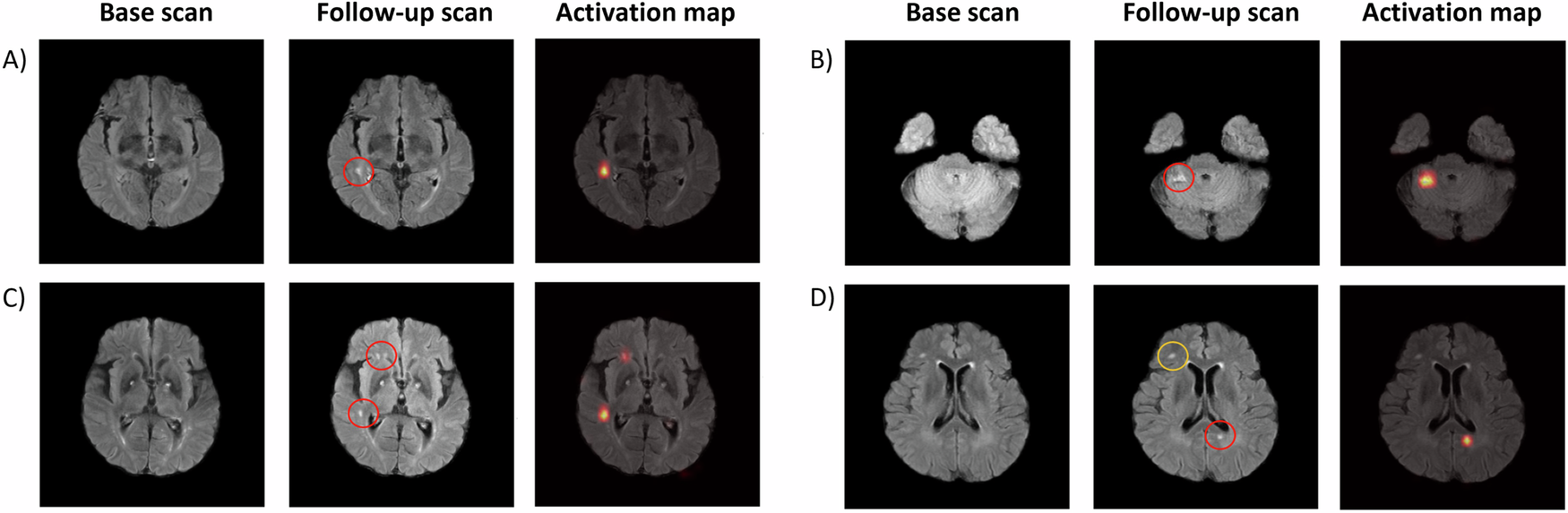
Examples comparing newly developed cerebral infarction lesions in baseline and follow-up MRI scans with the AI model’s detection results (Source: Cho et al., npj Digital Medicine, 2026, CC BY-NC-ND 4.0)
The study also found that the presence of newly developed cerebral infarctions showed a statistically significant association with patients’ future clinical outcomes, confirming the potential of AI-based serial MRI analysis for stroke prognosis prediction and long-term patient management.
This research was conducted through close collaboration between clinical medicine and engineering. Professor Seong-ho Park’s team defined the clinical problem and established the dataset, while Professor Hwan-ho Cho’s team designed and analyzed the AI model. Multiple medical institutions—including Hanyang University Guri Hospital, Inje University Paik Hospital, Samsung Medical Center, Asan Medical Center, and Korea University Ansan Hospital—also participated in the study, enhancing the reliability of the findings.
The research was published in March 2026 in npj Digital Medicine (Impact Factor: 15.1) under the title “Automated detection of new cerebral infarctions and prognostic implications using deep learning on serial MRI.” The journal ranks in the top 0.3% (1/118) in the JCR category of Health Care Sciences & Services and top 3.1% (2/48) in Medical Informatics.
Professor Hwan-ho Cho stated, “This study is meaningful in that it automatically detected clinically overlooked changes through collaboration between engineering and medicine and linked them to patient prognosis.” He added, “We plan to further expand this work into an AI-based system applicable to real clinical practice by integrating not only imaging data but also various types of clinical information.”
This research was supported by the Brain Science Leading Convergence Technology Development Program funded by the National Research Foundation of Korea and by internal research funding from Incheon National University.