

Designing solutions to space debris with coding, Center for Science and Culture in Incheon, visiting ‘Aerospace’ science camp successfully concluded
- 글번호
- 413358
- 작성일
- 2025-09-30
- 수정일
- 2025-09-30
- 작성자
- 홍보과 (032-835-9490)
- 조회수
- 734
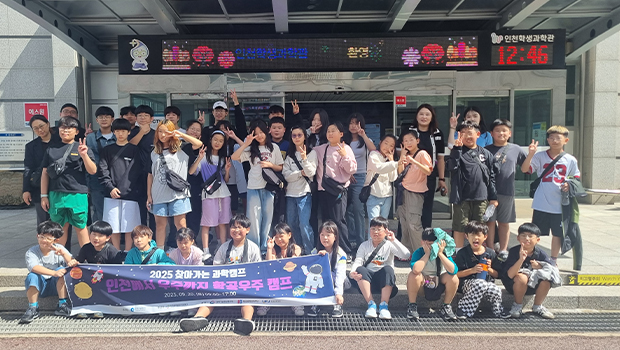
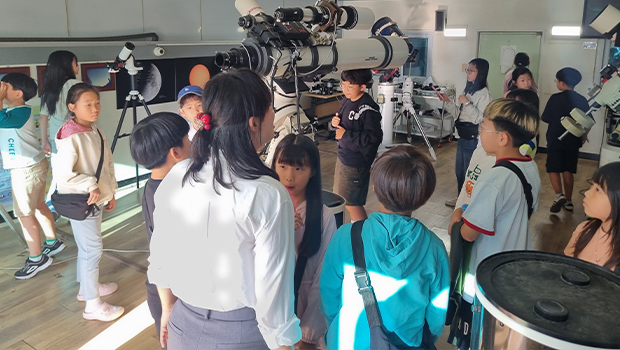
Center for Science and Culture in Incheon Aerospace Camp
The Center for Science and Culture in Incheon (Director: Kisoon Han, Professor of Creative Human Resource Development at Incheon National University) announced that it successfully held a visiting science camp on September 20 under the theme of “Aerospace.” This camp was part of the Center’s science camp program for underprivileged students, with a total of 38 participants ranging from 3rd-grade elementary school students to 3rd-grade middle school students.
In particular, the camp gained significance as it was held on Yeongjong Island, home to Incheon International Airport. Programs were conducted mainly at the Incheon Student Science Museum and Incheon Science High School, where participants engaged in hands-on learning activities based on aviation science and technology at key regional science education facilities. As the camp took place in a region central to the future aerospace industry, both students and parents showed high levels of interest.
At the Incheon Student Science Museum, programs were organized by floor to captivate students’ interest. On the first floor, students explored the aviation and aerospace exhibition hall, directly observing various flight principles and models. On the second floor, they experienced immersive learning through virtual reality (VR) space exploration and celestial simulations, as if traveling through outer space. On the third floor, students engaged in experiments on rocket propulsion principles and aerodynamics in the science lab, gaining hands-on understanding of scientific concepts. These step-by-step activities expanded students’ natural curiosity about science.
Through active participation, students were able to understand science in a fun and approachable way, expressing high satisfaction with the program overall. In particular, during the “Finding Solutions to Space Debris” activity, participants designed their own space debris removal methods using coding programs, presenting creative ideas. The subsequent group activities and presentations fostered collaborative problem-solving skills and were well received.
This visiting science camp was supported by the Korea Foundation for the Advancement of Science and Creativity (KOFAC). Incheon Science High School provided the venue, and teachers took the lead in organizing the programs, which enriched the overall experience. Additionally, project-based learning (PBL) encouraged students to explore problems in small teams, devise solutions, and share their ideas through presentations and discussions. This process nurtured both cooperative problem-solving abilities and scientific thinking skills, helping students view science as a practical tool for solving real-world problems rather than just knowledge.
Director Kisoon Han of the Center for Science and Culture in Incheon stated, “This visiting science camp went beyond a simple experience, as it addressed real scientific issues such as space debris at a level appropriate for children. We hope that participating students will develop creative problem-solving skills through coding and design activities and grow into future leaders in science and technology.”
Since 2021, the Center for Science and Culture in Incheon has been operated by the Incheon National University Institute for Science Gifted Education (www.inuisge.kr). The Center has been carrying out various programs to spread scientific culture in the community and reduce educational disparities. Last year, it collaborated with 90 regional institutions, serving approximately 170,000 Incheon citizens annually and establishing itself as a regional hub for science culture.
The Center’s programs are funded by the Science and Technology Promotion Fund and the Lottery Fund, with support from the Ministry of Science and ICT and KOFAC. These initiatives contribute not only to the development of science and technology in Korea but also to the welfare of low-income and underprivileged groups.